Archive for the ‘My Career and Personal Life’ Category.

Missing 5

Here is a probability puzzle I heard from my son Sergei. We even included this puzzle in our book Mathematical Puzzles and Curiosities. Our book includes the answer but omits the details. So, this blog post is devoted to said details.

Puzzle. Alice rolls a die until she gets 6. Then Bob observes that she never rolled a 5.
Question. What is the expected number of times that Alice rolled the die?

The answer depends on Bob’s strategy. Many people assume that Bob loves 5 and is only looking for 5. In this case, the answer is 3. Here is the argument: the expected number of rolls to get 5 or 6 is 3: this is equivalent to rolling a three-sided die and waiting to one side to appear. Only on the rolls without 5 will Bob say something.

However, there are other natural assumptions. In the book, we have two suggestions, where Bob treats every digit that is not 6 equally.

Modeling assumption 1. Suppose Bob lists all the numbers that are missing. Then, when he says that 5 is missing, we are guaranteed that Alice rolled 1, 2, 3, and 4 before 6. Such a strategy by Bob noticeably increases the expected number of rolls, and the answer is 8.7. Let us prove this.

This version of the problem is related to the coupon collector’s problem. Suppose we randomly get coupons, where the total number of coupons is 5, and we get each one with probability 1/5. How many coupons will we need to collect to get 4 different coupons? The first coupon appears immediately after one draw; after that, a different coupon appears with probability 4/5, which means the expected additional wait is 5/4. After we get the second coupon, the expected wait for the third coupon is 5/3. Continuing, the total wait for four different coupons to appear is 5/5 + 5/4 + 5/3 + 5/2 = 77/12.

However, we actually need 4 different coupons, not out of 5, but out of 6 to appear. That means that we need to multiply the answer by 6/5 to get 7.7. Then we add one extra roll for the final 6. The answer is 8.7.

Modeling assumption 2. Suppose Bob randomly chooses one number out of the ones that are missing. For example, if Alice rolled 1, 2, 3, 2, 1, 6, then Bob notices that 4 and 5 are missing, and mentions 5 with probability 1/2. In this case, the number of expected rolls is 4.26.

By using coupon-collecting ideas, we know, for each k, the expected number of rolls until k+1 distinct dice faces appear. To wit, for each k=0,1,2,3,4, the expected number of rolls is 1, 2.2, 3.7, 5.7, and 8.7, respectively.

Now we need to condition on the event that Bob actually says 5. By symmetry among the non-6 faces, the probability that Bob’s announcement is 5, given that he says something at all, is the same for each of the five digits. This conditioning does not bias the waiting time toward any particular missing digit, so the conditional distribution of the stopping time is obtained by averaging these expectations over the five possible values of k. Therefore, the expected number of rolls is (1 + 2.2 + 3.7 + 5.7 + 8.7)/5 = 4.26.

I am grateful to my other son, Alexey, for discussing this problem with me. Probability is a tricky subject, and it is nice to have experts in the family.


Share:Facebooktwitterredditpinterestlinkedinmail

Two Points on a Cube

I wrote a book. This is my first book, so I am very proud. I wrote it together with two brilliant puzzle lovers, Ivo Fagundes David de Oliveira and Yogev Shpilman. The book is published by World Scientific and is available for pre-order: Mathematical Puzzles and Curiosities. Here is one sample puzzle from the book.

Puzzle. The centers of two opposite faces of a cube are connected by four distinct shortest paths, shown in the picture in different colors. Can you find two points on the surface of a cube such that there are exactly three shortest paths connecting them?

Two Points on a Cube

This puzzle appeared in the latest issue of SLMath’s newsletter, 17 Gauss Way. The issue has a puzzle column that I coauthored with Joe Buhler and Pavlo Pylyavskyy. The coolest images in the column were done by Tracy Hicks, and this image is no exception. The picture is better than our original one in the book.


Share:Facebooktwitterredditpinterestlinkedinmail

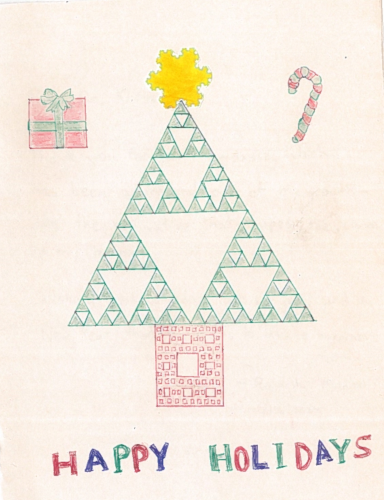
Happy Fractal Holidays!

Take a look at a card one of my students gave me last December. You can spot the Koch snowflake, the Sierpiński triangle, and the Sierpiński carpet on it. I guess my fractal class was a hit.

Happy Holidays card from a student

Share:Facebooktwitterredditpinterestlinkedinmail

Pledge of Honor

Guarantee of Honor

When I graduated high school, I got a special certificate I was absurdly proud of. It wasn’t about grades — students voted for these, supposedly to honor strength of character. The award was called the Pledge of Honor.

When you open it, the left-hand side has a quote attributed to Friedrich Engels: “A human is defined not only by what he does, but also by how he does it.”

I couldn’t find the official translation of this quote, so the above translation is my own. While I was searching, I found another quote: “The less you eat, drink, and read books, the less you have to shit, pee, and talk.” But I digress.

Before I explain what’s on the right-hand side of the award, a little context. I was a member of Komsomol, the Leninist Young Communist League in the Soviet Union. About 99% of students were members — not because of boundless zeal, but because not joining could hurt your chances of getting into college or landing a job. Back in high school, I was brainwashed into believing that the Komsomol was trying to do good, so I signed up as soon as I was eligible — I wasn’t thinking then about colleges or jobs.

Now I am ready to translate the right-hand side, which said: “The Komsomol organization of Moscow School No. 444 PLEDGES ON ITS HONOR that Tanya Khovanova will never, ever, anywhere disgrace the high calling of a Komsomol member.”

I lost my rose-colored glasses right after high school. How that happened is another story, but let’s just say the “never, ever” promise had a shelf life of about a month.

There was another, more prestigious certificate called the Torch-Carrier of Communism. Two students in my class received this honor. One of the torches soon moved to Israel.


Share:Facebooktwitterredditpinterestlinkedinmail

Alexander Karabegov’s Puzzle

When I was in 8th grade, I was selected to be part of the Moscow math team and went to Yerevan, Armenia, to participate in the All-Soviet Math Olympiad. A group of us boarded a bus, and Alexander Karabegov paid for all of our bus tickets. He was from Yerevan himself and wanted to be a gracious host. I was impressed. The next time I met him was when I started studying at the Moscow State University. We have been friends ever since. He was even the best man at one of my weddings. Now, he lives in Texas and sends me his original puzzles from time to time. Today, he sent me a new one.

WARNING. His solution to the puzzle is also included. So if you want to solve it yourself, stop reading after the next paragraph.

Puzzle. A number c is called a fixed point of a function f, if it is a solution of the equation f(x) = x; that is, if f(c) = c. Find all solutions of the equation g(g(x)) = x, where g(x) = x2 + 2x − 1; that is, find all fixed points of the function f(x) = g(g(x)). (We can assume that x is a real number.)

I gave the puzzle to my students, and they converted it to a fourth-order equation, which they solved using various methods. What I liked about Alexander’s solution is it only uses quadratic equations. I am too lazy to give his full solution. Here is just his solve path.

Solve path. If c is a fixed point of the function g(x), then it is a fixed point of f(x) = g(g(x)). Solving the equation g(c) = c gives us two fixed points. We need two more, as our equation is quartic. Suppose a is another fixed point. Let b = g(a). It follows that g(b) = a. Moreover, we can assume that a is not b, as we covered this case before. We get two equations a2 + 2a − 1 = b and b2 + 2b − 1 = a. Subtracting one equation from another, we get a quadratic equation that has to be divisible by a −b. As b is not a, by our assumption, we can divide the result by a − b, expressing b as a linear function of a. We plug this back into one of the two equations and get a quadratic equation for a, supplying us with the remaining two solutions. TADA!


Share:Facebooktwitterredditpinterestlinkedinmail

My Favorite Shoes

(A small piece I wrote on Dec 29, 2009. Edited in 2024.)

They were black, very comfy, and felt like a second skin. The shoes had this shock-absorbing cushioning, so asphalt felt like carpet.

I had them for 10 years. They served me for so long that I started believing our happy relationship would last forever.

First, I noticed that they are not black anymore. They acquired a greenish color. Then, the sound changed. Steps started sounding like farts. I trusted my shoes so much that, at first, I thought I was just getting old. But I realized that I couldn’t be that perfect: I couldn’t possibly fart with such a precise rhythm. Besides, I should have run out of gas from time to time.

When I came home, I took off my shoes and looked at them. The sole of one shoe was gone. My love affair with my shoes was over. Oh well. The divorce was easy. They went to my garbage can. No tears, no broken hearts, just a lost sole.

Share:Facebooktwitterredditpinterestlinkedinmail

Ikigai

Have you ever heard of ikigai? The Japanese concept which gives four simple requirements for a happy career:

  • Do what you love.
  • Do what you are good at.
  • Do what impacts the world.
  • Do what you can get paid for.

I often think about it for myself and for my students. Is this good advice for finding a career path?

I like that ikigai separates the first two requirements: passion and gift. Many of my students do not see the difference, as passion and gift are highly correlated. When you love something, you practice it and become better at it. When you are good at something, it becomes easy and enjoyable.

Nonetheless, passion and gift are different. Unfortunately, I’ve seen students who are good at math only because their parents push them, but they do not love it. Some of them already found their passion but are afraid to tell their parents. Some haven’t yet found their passion, but it is perfectly clear that math is not it. So, a gift doesn’t imply passion.

What about the other way around? My programs are too selective, so I haven’t seen students who are not gifted in math. I will use myself as an example. I have always passionately loved dancing, but it is obvious that my dancing career would have been a disaster. I am very happy I closed that career path in fifth grade.

Anyway, the first two ikigai requirements are not the same, and both are necessary.

The third ikigai requirement is about doing what the world needs. Impacting the world is a great motivator and makes you feel good. And yet, I see happy and successful mathematicians who only care about the beauty of what they are doing and nothing else. This requirement is important but might not be a deal breaker for everyone.

The last ikigai requirement is crucial. If you are not being paid for your efforts, it is not a career; it is a hobby. I got attracted to it because it includes an important caveat: you need to find people who want to pay you for what you can offer. I recently wrote an essay Follow Your Heart? about many young aspiring opera singers who ignored this last requirement and ended up changing careers.

Nevertheless, the whole concept of ikigai bugs me. People who find their dream job might agree to work for much less pay than they are worth. It opens them up to potential exploitation by greedy employers.

Have I reached my ikigai? Judging by my low pay, I am close.


Share:Facebooktwitterredditpinterestlinkedinmail

Mini Stupidity

My grandkids like playing a game while I drive. They look out the window to spot the cars they like and score points. A Jeep is 1, a convertible is 10, a Mini Cooper is 40, and a Bug is 100. If we are lucky and see a convertible Mini or Bug, we get 10 extra points for convertibility. I play with them, of course. As a result, I can recognize minis and bugs from hundreds of miles away (I am exaggerating).

Recently, a Mini annoyed me. I was driving behind one, warmly thinking about my grandchildren, when its right turn signal started flashing. The signal looked like an arrow pointing to the left. I got so confused that my grandkids flew from my mind.

When I came home, I started googling and discovered that Mini designers wanted the British symbolism on their cars. The right signal is reminiscent of the right half of the British flag.

UK flag
Mini Cooper Right Turn Signal

Here is the picture from Reddit with the left turn signal on.

Mini Cooper Turn Signal

I am writing this essay but afraid to show my grandkids these pictures. They would be maxi-disappointed with Minis.


Share:Facebooktwitterredditpinterestlinkedinmail

My Unique Christmas Card

One of the perks of being a teacher is receiving congratulations not only from family and friends, but also from students. By the way, I do not like physical gifts — I prefer just congratulations. Luckily, MIT has a policy that doesn’t allow accepting gifts of any monetary value from minors and their parents.

Thus, my students are limited to emails and greeting cards.

One of my former students, Evin Liang, got really creative. He programmed the Game of Life to generate a Christmas card for me. You can see it for yourself on YouTube at: Conway Game of Life by Evin Liang.

This is one of my favorite congratulations ever.

Share:Facebooktwitterredditpinterestlinkedinmail

A Bribe for a 5-Star Review

I buy almost everything on Amazon. Recently, I ordered a back stretcher. It took half an hour to assemble, and after the first use, it changed shape. However, this story is not about quality but about a card that was included with the item.

In the box, I found a gift card that wasn’t a gift card but rather a promise of a $20 Amazon gift card for a 5-star review. Hmm! A bribe for a good review.

I looked at the card more closely, and it had the following text.

WARM TIPS: Please DO NOT upload gift card pictures in the review; it will affect your account.

This is not only a bribe. It contains a threat.

Initially, I assumed it was Amazon, but it makes more sense that the company making this thingy is behind it. I gave Amazon the benefit of the doubt and went to their website to leave a 1-star review. I related the card’s story to warn others that the 5-star reviews can’t be trusted. Amazon rejected my review as it didn’t comply with their guidelines. Is Amazon in on it?

I wrote a different 1-star review, which did comply. It seems I can complain about the product, but I can’t complain about the bribe and threat.

I called Amazon’s customer service, and they promised to investigate. This was three months ago. This crappy product, with a stellar average 4.6 rating, is still out there.

Amazon Gift Card for a 5-Star Review

Share:Facebooktwitterredditpinterestlinkedinmail