Fresh Cute Logic Puzzles

Recently, I stumbled upon three lovely logic puzzles, while scrolling Facebook for news from the Russia-Ukraine war. I will start with an easy puzzle.

Puzzle. A traveler got to an island, where each resident either always tells the truth or always lies. A hundred islanders stood in a circle facing the center, and each told the traveler whether their neighbor to the right was a truth-teller. Based on these statements, the traveler was able to clearly determine how many times he had been lied to. Can you do the same?

In the next puzzle, there is another island where people are either truth-tellers or normal. There are three questions that increase in difficulty.

Puzzle. You are on an island with 65 inhabitants. You know that 63 inhabitants are truth-tellers who always tell the truth, and the other 2 are normal, who can either lie or tell the truth. You are allowed one type of question, “Are all the people on this list truth-tellers?” This question requires a list, which you can create yourself. Moreover, you can have as many different lists as you want. You can pose this question to any islander any number of times. Your goal is to find the two normal people. The easy task is to do it in 30 questions. The medium task is to do it in 14 questions. The hard task is to figure out whether it is possible to do it in fewer than 14 questions.

Here is the last puzzle.

Puzzle. You got to an island with 999 inhabitants. The island’s governor tells you, “Each of us is either a truth-teller who always tells the truth, or a liar who always lies. ” You go around the island asking each person the same question, “How many liars are on the island?” You get the following replies.
First person, the governor: “There is at least one liar on the island.”
The second person: “There are at least two liars on the island.”
This continues progressively until the 999th person says: “There are at least 999 liars on the island.”
What can you tell about the number of liars and truth-tellers on this island?


Share:Facebooktwitterredditpinterestlinkedinmail

Another Nine-Dots Puzzle

I recently wrote an essay, Thinking Inside and Outside the Box, which starts with a famous nine-dots puzzle that kicked off the expression: thinking outside the box. Here is another puzzle with the same nine-dots setup.

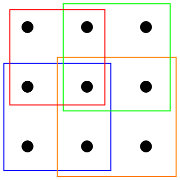
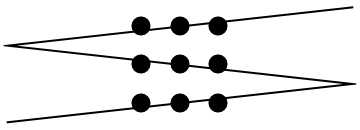
Puzzle. What is the smallest number of squares needed to ensure that each dot is in its own region?

9 dots puzzle


Usually, people who try to solve this puzzle come up with the following four-squares solution.

9 dots puzzle non-solution


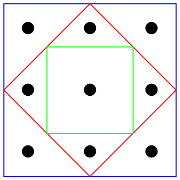
As with the classic nine-dots puzzle, they imagine that the dots are on a grid and try to build squares with sides parallel to the grid lines. What would be the outside-the-box idea? The sides of the squares would not need to be parallel to the grid. This way, we can solve the puzzle with three squares.

9 dots puzzle solution

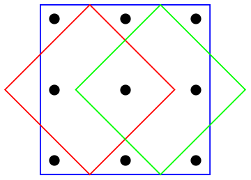
One of my MathRoots students offered a different and awesome solution also using three squares.

9 dots puzzle another solution

Share:Facebooktwitterredditpinterestlinkedinmail

A Number Theory Problem from the 43rd Tournament of Towns

Problem. Find the largest number n such that for any prime number p greater than 2 and less than n, the difference np is also a prime number.

Share:Facebooktwitterredditpinterestlinkedinmail

Thinking Inside and Outside the Box

The most famous thinking-outside-the-box puzzle is the Nine-Dots puzzle. This puzzle probably started the expression, “To think outside the box”. Here is the puzzle.

Puzzle. Without lifting the pencil off the paper, connect the nine dots by drawing four straight continuous lines that pass through all the dots.

9 dots puzzle

Most people attempt something similar to the picture below and fail to connect all the dots.

9 dots non solution

They try to connect the dots with line segments that fit inside the square box around the dots, mentally restricting themselves to solutions that are literally inside the box.

To get to the correct solution, the line segments should be drawn outside this imaginary box.

9 dots solution

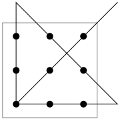
Do you think that four line segments is the best you can do? Jason Rosenhouse showed me a solution for this puzzle that requires only three lines. Here, the outside-the-box idea is to use the thickness of the dots.

9 dots solution with three lines

This and many other examples of thinking outside the box are included in my paper aptly titled Thinking Inside and Outside the Box and published in the G4G12 Exchange book.

A section of this paper is devoted to my students, who sometimes give unexpected and inventive solutions to famous puzzles. Here is an example of such a puzzle and such solutions that aren’t in the paper because I collected them after the paper was published.

Puzzle. Three men were in a boat. It capsized, but only two got their hair wet. Why?

The standard answer is the following: One man was bald.

Lucky for me, my creative students suggested tons of other solutions. For example,

  • One man was wearing a waterproof helmet.
  • The boat capsized on land, and two men had their hair already wet.

My favorite example, however, is the following.

  • One man didn’t have a head.

Share:Facebooktwitterredditpinterestlinkedinmail

A Mathematical Model for Gender Bias in Mathematics

I still get comments that my place is in the kitchen, and women shouldn’t do math. Luckily, occurrences of such events are getting rarer. So the world is progressing in the right direction. But gender bias still exists. Multiple studies show that among people of the same level of intelligence, men are perceived as smarter. In layman’s terms, people think women are stupider than they are. I will give my own examples at another time. But now, I want to discuss my model for gender bias.

Let’s denote the mathematical strength of a researcher by S. In real life, if the researcher is female, people perceive her strength as smaller than S. Let us assume that there exists a bias coefficient B, a number between 0 and 1 so that a female researcher of strength S is perceived on average as having strength BS. When B is 1, then there is no bias. But the world is not there yet.

In recent years, there has been a push to hire female mathematicians. Suppose a math department has a cutoff C for hiring a math professor. Being eager to hire a female professor, the department slightly reduces the cutoff by the bias reduction coefficient R, where R is a number between 0 and 1. Thus, the cutoff to hire a female professor becomes RC, which is less than C.

Now consider Alice, who has mathematical strength S, such that SCBSRC. She is perfectly qualified to be hired by the department independent of her gender. However, the department members, on average, perceive her strength as not good enough for a male hire but good enough for a female one. Alice is hired. What happens as a result?

Many male colleagues are angry. They think that because of Alice, they couldn’t hire a male candidate they believe to be stronger. They also expect Alice to be grateful for the opportunity. How will Alice react? It depends on whether Alice herself is biased. I will give two potential scenarios.

Scenario 1. Alice is biased and realizes she is only hired because she is female. Alice thinks that her strength is below the cutoff C. Alice develops impostor syndrome and doesn’t contribute to the department and mathematics as much as she could have, reinforcing everyone’s belief that she is weaker than she actually is.

Scenario 2. Alice is not biased but realizes that she was hired for her gender and not for her mathematics. She gets angry too because she knows she is perfectly qualified. She also realizes that the department expects her to be grateful, while another male hire is thanked for taking a similar position. In this scenario, everyone is angry.

In both scenarios, the intent is to fight the bias. But as a result, no one is truly happy. A supportive environment is not created. And the idea that male and female mathematicians differ in strength is reinforced.

Recently, I talked to a male colleague about gender bias. He was adamant that he isn’t biased and, as proof, described his contribution to hiring females in his department. This is not proof of being unbiased. This is proof of trying to resolve the bias, either sincerely or due to outside pressure. However, the real proof would be to change one’s attitude towards female colleagues. As a female colleague myself, I would notice this change in attitude. But while nothing changes, I can’t accept the fact of female hires as proof of no bias.

To truly resolve the bias, we need B to be equal to 1. To improve the situation, people should collectively work on increasing the bias coefficient B. This is more about changing the attitude.

I am for hiring more female mathematicians as professors. But sometimes, I feel like hiring more female mathematicians without addressing the attitude is treating the symptoms while making the disease worse.

Share:Facebooktwitterredditpinterestlinkedinmail

A Logic Puzzle about Sophists

I love knights-and-knaves puzzles: where knights always tell the truth, and knaves always lie. The following puzzle has a new type of person: a sophist. A sophist only makes statements that, standing in their place, neither a truth-teller nor a liar could make. For example, standing next to a liar, a sophist might say, “We are both liars.” Think about it. If the sophist was a truth-teller, then the statement would have been a lie, thus creating a contradiction. If the sophist was a liar, the statement would be true, again creating a contradiction.

Here is the puzzle with sophists. And by the way, this one is intended for sixth graders.

Puzzle. You are on an island inhabited by knights, knaves, and sophists. Once upon a time, a sophist made the following statements about the island’s inhabitants:
1. There are exactly 25 liars on this island.
2. There are exactly 26 truth-tellers on this island.
3. The number of sophists on this island is no less than the number of truth-tellers.
How many inhabitants were on the island once upon that time?

I love this new sophist character in logic puzzles, but I have no clue why they are called sophists. Can anyone explain this to me?

Share:Facebooktwitterredditpinterestlinkedinmail

My New Favorite Russian Plate

As my readers know, I collect Russian license plates. They are actually American plates, but the letters form words readable in Russian. This is possible because the shapes of English and Russian letters overlap. Here is my new favorite plate. It is actually not the best plate, but rather makes the best picture ever.

MOCKBA

The plate says Moscow, the Russian capital. And the car is parked next to the Ukrainian flag. I am from Moscow too, and I too support Ukraine in its war against evil Putin, who wants to restore the Russian Empire. Did you know that now he wants Alaska?


Share:Facebooktwitterredditpinterestlinkedinmail

Brick Puzzle

After reading my post, Shapovalov’s Gnomes, Grant, one of my readers, directed me to the Brick puzzle from Section 2.3 of Xinfeng Zhou’s A Practical Guide to Quantitative Finance Interviews.

Puzzle. Can you pack 53 bricks with dimensions 1-by-1-by-4 into a 6-by-6-by-6 box?

The solution in Zhou’s book has some flaws. So I am posting my own solution here.

Solution. We start with a sanity check. The box contains 216 unit cube cells, and 53 bricks would take up 212 cells. So there is no contradiction with the volume. We need to look at something else.
Let’s divide the box into 27 smaller 2-by-2-by-2 boxes and color the smaller boxes in a checkerboard manner. We get 13 boxes of one color, say white, and 14 boxes of another color, say black. Whichever way we place a brick inside the original box, it has to cover 2 white cells and 2 black cells. But we have a total of 104 white cells, which is only enough for 52 bricks.

Share:Facebooktwitterredditpinterestlinkedinmail

Cool New Coin Problems

Alexander Gribalko designed a new coin problem, two versions of which appeared at the 43rd Tournament of the Towns. I will start with the easier version.

Problem. Alice and Bob found eleven identical-looking coins; four of them are fake. All real coins weigh the same. All fake coins weigh the same but are lighter than the real ones. Alice offered Bob four specific coins. Before agreeing to take them, Bob wants to ensure they are all real. Can he do so by only using the balance scale twice? He can use any of the eleven coins for weighing purposes.

Surprisingly, the more difficult version has fewer coins.

Problem. Alice and Bob found eight identical-looking coins; three of them are fake. All real coins weigh the same. All fake coins weigh the same but are lighter than the real ones. Alice offered Bob three specific coins. Before agreeing to take them, Bob wants to ensure they are all real. Can he do so by only using the balance scale twice? He can use any of the eight coins for weighing purposes.

Share:Facebooktwitterredditpinterestlinkedinmail

Tricky Probabilistic Arguments

The Conway subprime Fibonacci sequence is defined as follows. Start with the Fibonacci sequence 0, 1, 1, 2, 3, 5, …, but before you write down a composite term, divide it by its least prime factor. Thus, the next term after 5 is not 8, but rather 8/2 = 4. After that, the sum gives us 5 + 4 = 9, which is also composite. Thus, you write 9/3 = 3, then 4 + 3 = 7, which is okay since it is prime, then 3 + 7 = 10, but you write 10/2 = 5, and so on. Here is the sequence: 0, 1, 1, 2, 3, 5, 4, 3, 7, 5, 6, 11, 17, 14, 31, and so on.

My coauthors, Richard Guy and Julian Salazar, and I studied this sequence in our paper Conway’s subprime Fibonacci sequences, in which we allowed any two integers to be the two starting terms. Our computation showed that for small starting terms, the sequence starts cycling. In our first draft, we had a probabilistic argument as to why the sequence should always cycle. Our argument was the following.

Flawed probabilistic argument. Consider the parity of the numbers in a particular subprime Fibonacci sequence. I will leave it to the reader to see that such a sequence can’t have all even numbers. As soon we get to an odd number, the even numbers in the sequence become isolated. Indeed, if two numbers have different parity, the next number must be odd. For subprime Fibonacci sequences, when we add two odd numbers, there is a 50 percent chance that after dividing by 2, the result will be odd. Assuming the result is odd, there a is 25 percent chance the next number will be odd as well. And this pattern continues. Thus, as soon as we get two odd numbers in a row, on average, we expect three odd numbers in a run of odd numbers. Hence, we would expect a typical subprime Fibonacci sequence to have three times as many odd as even numbers.
This means, on average, two consecutive terms sum to an even number half of the time. Therefore, while calculating the next term, we divide by 2 with probability 1/2 and by 3 with probability 1/6. Ignoring larger primes, on average, we expect to have divided by at least 1.698, while the usual Fibonacci growth is only by a factor φ, which is approximately 1.618. We see that the subprime Fibonacci sequence is divided faster than its expected growth rate. Thus, it has to cycle.

However, this argument doesn’t work. When we submitted the paper, an anonymous reviewer pointed out that the argument was flawed. Here I want to explain why. I will start with a counterexample suggested by my sons, Alexey and Sergei.

Counterexample. Start with two real numbers. Suppose the sequence is to add the two previous numbers and divide the sum by 1.8 (which is greater than the golden ratio φ). The resulting sequence grows as a geometric progression with ratio 1.07321.

Here is a variation of the above argument.

Counterexample Variation. Suppose we have a sequence where we add the two previous numbers and then divide the sum by 2. We are dividing by a noticeably larger number than the golden ratio. By our flawed argument earlier, the sequence should decrease. But if we start such a sequence with two identical numbers n and n, the sequence will be constant, disproving the argument.

Here is an additional observation. Obviously, whenever we add two numbers and divide the sum by a number bigger than 2, the sequence has to cycle. Indeed, the maximum of two consecutive terms decreases. Can we add probabilities to this argument? Below is the averaging version of this argument for the subprime Fibonacci numbers. Unfortunately, this argument is also flawed.

Another flawed probabilistic argument. We need to show that, on average, at each step, we divide our sum by a number bigger than 2. We can ignore divisions by 2 as they are fine. Let’s see what happens with sums that we do not divide by 2. With probability 1/3, we divide them by 3. If not, with probability 1/5, we divide them by 5. Otherwise, with probability 1/7, we divide them by 7. Hence, if we do not divide our sum by 2, then with probability 1/3, we divide it by 3, plus with probability 2/15, we divide it by 5, plus with probability 8/105, we divide it by 7. Thus, on average, if we do not divide the sum by 2, then we divide it by at least 31/352/1578/105 = 2.07.

Counterexample to the second argument. Why is this wrong? Let us, for example, consider a sequence with the following recursions: a2k+1 = a2k + a2k-1. And a2k = (a2k-1 + a2k-2)/x, where x is a very large number. Then on average, we divide the sum by a very large number. Would this sequence converge to zero? If we look at it more closely, the subsequence of odd-indexed numbers increases. So the answer is no.

We found yet another probabilistic argument that the sequences shouldn’t increase indefinitely. We are sure that one works. Our anonymous reviewer was happy with it too. You can find the argument in our paper: Conway’s subprime Fibonacci sequences.

But I wrote this essay to show how tricky probabilistic arguments can be.


Share:Facebooktwitterredditpinterestlinkedinmail