Is Shopping Good for the Economy? Lessons from “Settlers of Catan.”

My son Alexey taught me to play “The Settlers of Catan .” This game is so good that throughout the four years of his undergraduate studies, he played it every evening. I am exaggerating of course, but only so slightly. He also taught me some of the game’s wisdom.
Lesson 1. Trading is beneficial for both traders.
When you agree to exchange your two rocks for one grain, one grain is more valuable to you than two rocks. The opposite is true for your trading partner.
Presumably, the same principle works for the economy. If I buy a sweater at T.J.Maxx for $20, I need the sweater more than $20. And if the store sells this sweater for $20, they are hoping to make some profit, that is, that the sweater cost them less than $20. Supposedly, shopping transactions are profitable for both parties.
Lesson 2. Trading is bad for non-trading players.
This is the consequence of the fact that in “Settlers of Catan” there is only one winner. If something is good for someone, it is bad for everyone else. In real life you do not have to lose if someone wins. With each shopping transaction everyone gains. This is the reason why shopping must be good for the economy.
Lesson 3. Powerful players can persuade other players to trade against their best interests.
Shortly after I moved to the US, I became very aware of my own smell. My smell didn’t change with my move from Russia, nor did my sense of smell change. I was just bombarded with deodorant advertisements, and due to the vulnerability of my self-perception, in one year I bought more deodorants than in all my previous 30 years. I have a friend who has an exceptional sense of smell. He told me that people often use much more deodorant and perfume than they need.
Lesson 4. You pay a lot for storage.
In Settlers, if you have more than seven cards and the dice rolls seven, you need to discard half of your hand. So if you have six cards and someone offers you three grains for one sheep, consider the storage price before jumping into this bargain deal.
Once I bought so much discounted toilet paper that it lasted me for months and months. When it was time to move to a different apartment, I had to pay for the largest truck available to fit all my junk.
Lesson 5. It is important to understand the goal of the person you are trading with.
A profitable deal becomes a big mistake when, as a result of the trade, your trading partner builds a settlement right in the spot where you were planning to build.
Similarly, if your doctor prescribes you a medication, it would behoove you to know whether he will reap any profit from it himself.
Lesson 6. If a player is the only receiver of rock in the game he dictates the price.
This is like a monopoly. I needed my last laptop more than the $1,000 I paid for it. But this price included pre-installed Windows, which I didn’t want and which I immediately deleted. I was forced to pay extra for Windows because of Microsoft’s monopoly.
So, is shopping good for the economy?
What about that skirt I bought and never used and eventually threw away? I wasted $20 on it. But the store didn’t gain that $20; they only gained their profit margin, which could have been $5. That means that together we wasted $15.
I do not throw away every piece of clothing I buy, but it is true that we buy more things than we need.
I think that going shopping to help our country get out of an economic crisis is a ridiculous idea. If you are shopping for other reasons than necessity, you do not help anyone and as a group we lose.
My son Alexey wins almost every game of “Settlers of Catan” he plays. So does my friend Mark Shiffer. The main reason is that they both know how to use trading effectively. To me that indicates that there are probably other people out there who know how to effectively sell deodorants, pills, clothing and other junk to us. I suspect that I lose in every shopping transaction, as I am an unskilled trader. If most folks are like me, could it be that shopping is actually bad for the economy?
Share:



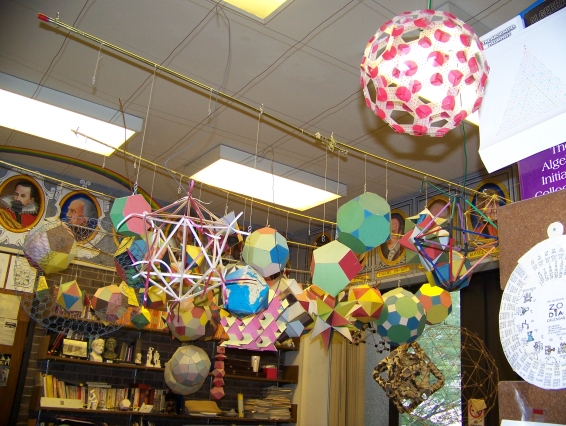 Visitors to the math department of Princeton University used to stop by John Conway’s office. Even if it were closed, they could peek through the window in the door to see the many beautiful, symmetric figures hanging in his office.

