Author Archive

Conway’s Circle

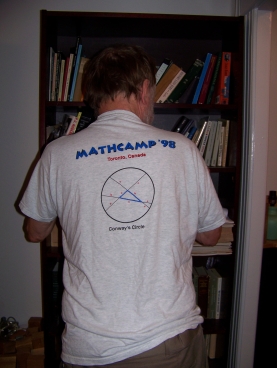
Conway's backJohn Conway has a T-shirt with his theorem on it. I couldn’t miss this picture opportunity and persuaded John to pose for pictures with his back to me. Here is the theorem:
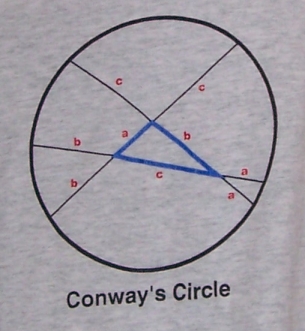

If you continue the sides of a triangle beyond every vertex at the distances equaling to the length of the opposite side, the resulting six points lie on a circle, which is called Conway’s circle.

Conway's circle

Poor John Conway had to stand with his back to me until I figured out the proof of the theorem and realized which point must be the center of Conway’s circle.


Share:Facebooktwitterredditpinterestlinkedinmail

Equal Numbers

Heard somewhere:

Teacher: What’s bigger: 22/7 or 3.14?
Student: They are equal.
Teacher: Why do you say that?!
Student: They are both equal to π.

Share:Facebooktwitterredditpinterestlinkedinmail

007

007 officeFor the last three years I’ve been coming to the Institute for Advanced Study in Princeton every spring for the Women and Mathematics program. Every year I am assigned to an office in the main building: Fuld Hall.

The problem is that there is a different office that I crave. Every year I go and check on it over in Simonyi Hall, where the Mathematics Department is located. This year I took this photo of the empty name-tag, hoping that one day it will say Tanya Khovanova.


Share:Facebooktwitterredditpinterestlinkedinmail

Father’s Maiden Name

Credit cards often keep your mother’s maiden name in their database for security purposes. This so called “security” is based on two assumptions:

  • Your mother was married.
  • Your mother changed her last name to her husband’s last name.

Were these assumptions true, only your close relatives would know your mother’s maiden name. In reality, if your mother was never married, then your last name is the same as your mother’s last name. So, crooks who are trying to steal identities can try to use your last name as your mother’s presumed maiden name. Very often they will succeed. Besides, many women do not change their last names. If you have a different last name from your mother, but your mother uses her maiden name, then the bank’s security question is not very secure at all.

If you want your identity to be secure you might need to invent a maiden name for your mother. Alternatively, perhaps your parents can tell you a family secret that will help you choose a name that is related to you, but not transparent to the public.

My relative Martin took his wife’s last name after their marriage. Before his children apply for credits cards and bank accounts, he needs to explain to them that it is better for them to use his maiden name as their mother’s maiden name for banking purposes.

Share:Facebooktwitterredditpinterestlinkedinmail

Russian Solidarity

I was driving on MassPike when, for no apparent reason, a car driving in the opposite direction started flashing its headlights. I remembered the Russian tradition of informing the oncoming traffic that the police are nearby. So I adjusted my speed and very soon I saw a police car. I got this warm feeling in my heart because I didn’t need to panic or check my speedometer. I mentally thanked that anonymous Russian driver and started wondering why the tradition had not been adopted in the USA. Is it because we are so responsible that we want to punish speeders, or do we think that the police are on our side?

Share:Facebooktwitterredditpinterestlinkedinmail

On Mice and Coins

The following problem was sent to me by Joel Lewis.

You have 12 mice, one of which eats faster than all the others. You need to find it. You have a supply of standard cupcakes that you value very much and want to minimize how many of them you have to use. The only way you can find the mouse is to give cupcakes to several groups of mice and see which group is the fastest.

We assume that mice chew at a constant speed and all the mice in one group can attack the cake at the same time. I love this puzzle because I love coin problems. Let me restate the puzzle as a coin problem:

You have 12 coins, one of which is fake and weighs less than all the others. You have a balance scale with multiple pans, that is you can weigh several things at once and order them by weight. You do not care about the total number of weighings as in most classical coin puzzles, instead, this time using a pan is expensive and you want to find the fake coin with as few pan-uses as possible.

Spoiler warning: below I will discuss the solution for n mice.

You can, of course, give a cake to every mouse and see which one finishes first. You can save one cake by giving cakes at the same time to all but one of the mice. If everyone finishes simultaneously, the faster mouse is the unfed one.

It wastes cakes to give them to unequally-sized groups of mice. We can do better by copying the classical way to find a fake coin with the minimum number of weighings. That is, for each test, divide the mice into three groups as evenly as possible and give a cake to each of two equally-sized groups. The number of cakes you use is about 2log3n.

I wouldn’t have written this essay if that was the solution. Sometimes you can do even better. For example, you can find the faster mouse out of 12 using only 5 cakes.

First, if you give out k cakes in one test, the test tells you which of k+1 groups the mouse is in. In the worst case, the faster mouse will be in the biggest group, so you should minimize the biggest group. Hence, your groups that get cakes should have ⌈n/(k+1)⌉ mice.

A test with one cake gives no information. I argue that giving out more than three cakes doesn’t gain anything. Indeed, suppose we use four cakes in a test. That is, we divide the mice into five groups A, B, C, D and E, of which the first four are the same size. We can simulate the test by two tests in each of which we give out two cakes. In the first test we give cakes to A+B and C+D. If one of the groups is faster, say A+B, then in the second test give cakes to A and B; if not, E has the faster mouse. I leave it as an exercise to simulate a test with more than four cakes.

Thus, in an optimal strategy we can use two or three cakes per test. Also, if you give one test with k − 1 cakes and the next one with m − 1 cakes, you can switch them with the same effect. The largest group after either order of tests will have at most ⌈n/km⌉ mice.

I don’t need two tests of three cakes each, which would give me a group of size at least ⌈n/16⌉. I can achieve the same result with three tests of two cakes each, with the faster mouse restricted to a group of size at most ⌈n/27⌉.

That means all my tests use two cakes, except I might use three cakes once. It doesn’t matter in what order I conduct the tests, so I can wait until the end to use three cakes. I leave it as an exercise to the reader that the only small number of mice for which we would prefer three cakes is four. From this it follows quickly that for numbers of mice between 3 * 3i + 1 and 4 * 3i, the number of cakes is 2i + 1. For numbers between 4 * 3i + 1 and 3i+2 the answer is 2i + 2.

Share:Facebooktwitterredditpinterestlinkedinmail

USAMO 2007, Problem 5

A week ago I chatted with my son Sergei about memorable math problems. He mentioned problem 5 from USAMO 2007. The problem can be reduced to the following:

Prove that (x7 + 1)/(x + 1) is composite for x = 77n, where n is a non-negative integer.

Perhaps Sergei remembered this problem because as far as he knew, he was the only one in that competition to solve it. That made me curious as to how he solved it. His solution is available as solution 2 at the Art of Problem Solving website. His solution seemed mysterious and impossible to invent on the spot. I became even more curious to understand the thought process underlying his solution.

Here is his recollection:

We need to factor x6 − x5 + x4 − x3 + x2 − x + 1. If such factoring existed it would have been known. Therefore, we need to somehow use the fact that x = 77n. What is the simplest way to factor? We should try to represent the polynomial in question as the difference of squares. Luckily, x is an odd power of 7. We can make it a square if we multiply or divide it by 7 or another odd power of 7. So with a supply of squares on one side, we need to find a match for one of them to build the difference.

Let us simplify the problem and see what happens for (y3 + 1)/(y + 1) for y = 33n, when n = 1. In other words we want to represent 703 as a difference of squares. This can be done: 703 = 282 − 92. Now let us see how we can express 282 and 92 through y which in this case is equal to 27. The first term is (y + 1)2, and the second is 3y.

Now let’s go back to 7 and x, and check whether (x + 1)6 − (x6 − x5 + x4 − x3 + x2 − x + 1) is 7x. Oops, no. The difference is 7x5 + 14x4 + 21x3 + 14x2 +7x. On the plus side, it is divisible by 7x which we know is a square. The leftover factor is x4 + 2x3 + 3x2 +2x + 1, which is a square of x2 +x + 1.

The problem is solved, but the mystery remains. The problem can’t be generalized to numbers other than 3 and 7.

Share:Facebooktwitterredditpinterestlinkedinmail

The Rise of MIT

I decided to take a closer look at the Putnam Competition. I analyzed the results of the three top contenders for the best Putnam teams: Harvard, MIT, Princeton. I looked at the annual number of Putnam Fellows from each of these three schools starting from 1994.

Year Harvard MIT Princeton
1994 2 0 1
1995 3 0 0
1996 2 0 0
1997 4 0 0
1998 2 0 1
1999 2 1 0
2000 2 2 0
2001 2 1 0
2002 2 2 0
2003 1 2 1
2004 0 3 2
2005 2 3 1
2006 1 3 0
2007 1 2 1
2008 1 3 0
2009 1 2 0

As you may notice MIT couldn’t even generate a Putnam Fellow until 2000, but starting from 2003 MIT consistently had more Putnam Fellows than Harvard or Princeton.

Richard Stanley, the coach of the MIT team, kindly sent me the statistics for the most recent competition, held in 2009.

Category Overall MIT
Number of participants 4036 116
Mean score 9.5 34.7
Median score 2 31
Geometric mean 0 0
Percent of 0 score 43.7 4.3

Furthermore, MIT had 40% in the top 5, 33% in the top 15, 32% in the top 25, and 35% in the top 81. For comparison, in the top 81, MIT had 28 winners — more than the next three schools together: Caltech 11, Harvard 9, Princeton 7.

No comment.

Share:Facebooktwitterredditpinterestlinkedinmail

The Best Math Blogs

OnlineDegree.net selected the 50 Best Blogs for Math Majors, and I am pleased that Tanya Khovanova’s Math Blog is number two. Since they did not explain their criteria, I suspected that it might be according to the number of Google hits. To double check, I Googled “math blog” and once again my blog was number two.

This might be the right moment to acknowledge the others involved with my blog. First, Sue Katz, my writing teacher and editor, corrected the English in most of my posts. Now I do not “do” mistakes in English any more, I make them.

My sons, Alexey and Sergei, are a huge support. Sometimes my poor kids have to listen endlessly to my latest idea, until I am ready to write about it. And then they will even read the final piece, and continue to encourage me.

But the most important motivators are you, my readers. Your comments, your personal emails and your feedback keep me writing.

Share:Facebooktwitterredditpinterestlinkedinmail

An Algebra Text Book

Introduction to AlgebraI am usually disappointed with American math text books. I have had an underwhelming experience with them. Often I open a book and in the next 15 minutes, I find a mistake, a typo, a misguided explanation, sloppiness, a misconception or some other annoyance.

I was pleasantly surprised when I opened the book Introduction to Algebra by Richard Rusczyk. I didn’t find any flaws in it — not in the first 15 minutes, and not even in the first hour. In fact, having used the book many times I have never found any mistakes. Not even a typo. This was disturbing. Is Richard Rusczyk human? It was such an unusual experience with an American math book, that I decided to deliberately look for a typo or a mistake. After half a year of light usage, I finally found something.

Look at problem 7.3.1.

Five chickens can lay 10 eggs in 20 days. How long does it take 18 chickens to lay 100 eggs?

There is nothing wrong with this problem. But the book is accompanied by the Introduction to Algebra Solutions Manual in which I found the following solution, that I’ve shortened for you:

The number of eggs is jointly proportional to the number of chickens and the amount of time. One chicken lays one egg in 10 days. Hence, 18 chickens will lay 100 eggs in 1000/18 days, which is slightly more than 55 and a half days.

What is wrong with this solution? Richard Rusczyk is human after all.

I like this book for its amazing accuracy and clean explanations. There are also a lot of diverse problems in terms of difficulty and ideas. Richard Rusczyk has good taste. Many of the problems are from different competitions and require inventiveness. I like that there are a lot of challenge problems that go beyond the boring parts of algebra. Also, I like that important points of algebra are chosen wisely and are emphasized.

This book might not be for everyone. It doesn’t have pretty pictures. It doesn’t have color at all. This is not a flaw for a math book. The book concentrates on ideas and problems, not entertainment. So if you’re looking for math entertainment, you’ll find it on my blog. For solid study, try Richard Rusczyk’s books.

Share:Facebooktwitterredditpinterestlinkedinmail