The Greatest Mathematician Alive
When the Abel Prize was announced in 2001, I got very excited and started wondering who would be the first person to get it. I asked my friends and colleagues who they thought was the greatest mathematician alive. I got the same answer from every person I asked: Alexander Grothendieck. Well, Alexander Grothendieck is not the easiest kind of person to give a prize to, since he rejected the mathematical community and lives in seclusion.
Years later I told this story to my friend Ingrid Daubechies. She pointed out to me that my spontaneous poll was extremely biased. Indeed, I was asking only Russian mathematicians living abroad who belonged to “Gelfand’s school.” Even so, the unanimity of those responses continues to amaze me.
Now several years have passed and it does not seem that Alexander Grothendieck will be awarded the Prize. Sadly, my advisor Israel Gelfand died without getting the Prize either. I am sure I am biased with respect to Gelfand. He was extremely famous in Soviet Russia, although less well-known outside, which may have affected the decision of the Abel’s committee.
I decided to assign some non-subjective numbers to the fame of Gelfand and Grothendieck. On Pi Day, March 14, 2010, I checked the number of Google hits for these two men. All the Google hits in the rest of this essay were obtained on the same day, using only the full names inside quotation marks.
- Alexander Grothendieck — 95,600
- Israel Gelfand — 47,900
Google hits do not give us a scientific measurement. If the name is very common, the results will be inflated because they will include hits on other people. On the other hand, if a person has different spellings of their name, the results may be diminished. Also, people who worked in countries with a different alphabet are at a big disadvantage. I tried the Google hits for the complete Russian spelling of Gelfand: “Израиль Моисеевич Гельфанд” and got an impressive 137,000.
Now I want to compare these numbers to the Abel Prize winners’ hits. Here we have another problem. As soon as a person gets a prize, s/he becomes more famous and the number of hits increases. It would be interesting to collect the hits before the prize winner is announced and then to compare that number to the results after the prize announcement and see how much it increases. For this endeavor, the researcher needs to know who the winner is in advance or to collect the data for all the likely candidates.
- Jean-Pierre Serre — 63,400
- Michael Atiyah — 34,200
- Isadore Singer — 44,300
- Peter Lax — 118,000
- Lennart Carleson — 47,500
- Srinivasa Varadhan — 15,800
- John Thompson — 1,610,000
- Jacques Tits — 90,900
- Mikhail Gromov — 61,900
John Thompson is way beyond everyone else’s range because he shares his name with a famous basketball coach. But my point is that Gelfand and Grothendieck could have been perfect additions to this list.
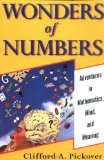
I have this fun book at home written by Clifford Pickover and titled Wonders of Numbers: Adventures in Mathematics, Mind, and Meaning
The most puzzling thing about this list is that there is no overlap with the Abel Prize winners. Here is the list with the corresponding Google hits.
- Andrew Wiles — 64,900
- Donald Coxeter — 25,200
- Roger Penrose — 214,000
- Edward Witten — 45,700
- William Thurston — 96,000
- Stephen Smale — 151,000
- Robert Langlands — 48,700
- Michael Freedman — 46,200
- John Conway — 203,000
- Alexander Grothendieck — 95,600
Since there are other great mathematicians with a lot of hits, I started trying random names. In the list below, I didn’t include mathematicians who had someone else appear on the first results page of my search. For example, there exists a film director named Richard Stanley. So here are my relatively “clean” results.
- Martin Gardner — 292,000
- Ingrid Daubechies — 76,900
- Timothy Gowers — 90,500
- Persi Diaconis — 84,700
- Michael Sipser — 103,000
- James Harris Simons — 107,000
- Elliott Lieb — 86,100
If prizes were awarded by hits, even when the search is polluted by other people with the same name, then the first five to receive them would have been:
- John Thompson — 1,610,000
- Martin Gardner — 292,000
- Roger Penrose — 214,000
- John Conway — 203,000
- Stephen Smale — 151,000
If we had included other languages, then Gelfand might have made the top five with his 48,000 English-language hits plus 137,000 Russian hits.
This may not be the most scientific way to select the greatest living mathematician. That’s why I’m asking you to tell me, in the comments section, who you would vote for.
Share:



Felipe Pait:
I am not qualified to judge which mathematicians deserve the Abel prize. However I recall someone describing Ingrid Daubechies book on wavelets as reading like a Russian novel. Besides her, Roger Penrose and VI Arnold have written mathematical books so beautiful as to move one to tears. If there were a Nobel, Abel, or some other Scandinavian Prize for Literature in Mathematics, the 3 of them, together with Martin Gardner and Tim Gowers, would get my votes.
20 March 2010, 4:31 pmFelipe Pait:
As I wrote above, I am not qualified to judge who deserves the highest prizes in Math. Grothendieck, Wiles, and Witten, and certainly some of the others, have certainly done deeper work than other people who may be more “popular” so to speak. That is why rankings of influence (on other mathematicians), popularity (among the expanded public) diverge from the most prestigious awards.
20 March 2010, 4:38 pmArelcao Akleos:
Alive, and not yet won the Abel, and should? Sullivan.
20 March 2010, 5:50 pmmisha:
I hope some day they will give Abel to Grisha Perelman, but make an exception for him by not offering any money. He will be happy to accept. Come to think about it, Abel and Perelman are so much alike…
30 March 2010, 9:34 ambrie finegold:
It seems like the mathematicians with the most hits all have fairly common names.
30 March 2010, 8:30 pmMaybe if you added the word “math” to the search, it would narrow down the number of hits to be more representative of what you are looking for. Also, do you get a different number from using google scholar?
Maria Roginskaya:
When one start to discuss “Who is the greatest?”, I always recall a passage from a Mark Twain novel (if I don’t mistake the source), where the hero dies and get to the Heaven. At some point he is shown a gathering of great millitary strategists: He recognizes some of the group, but not the one who is seating on the most high place and is pointed him as “the greatest”. After a question the guide explain to him that the man was born in a family of peasants in a small village at a time of peace, so he have never got to lead an army and was considered a fool by his neighbours.
I think the question you address above is actually “Who is the most famous mathematician?”
3 April 2010, 12:43 pmTanya Khovanova:
The 10 best mathematicians according to Alex Bellos:
https://www.guardian.co.uk/culture/2010/apr/11/the-10-best-mathematicians
Pythagoras (circa 570-495BC)
16 April 2010, 6:46 pmHypatia (cAD360-415)
Girolamo Cardano (1501 -1576)
Leonhard Euler (1707- 1783)
Carl Friedrich Gauss (1777-1855)
Georg Cantor (1845-1918)
Paul Erdös (1913-1996)
John Horton Conway (b1937)
Grigori Perelman (b1966)
Terry Tao (b1975)
Chuck:
I would say Terrence Tao. Although, the others are pretty great, too.
20 April 2010, 3:49 pmAlex Bellos » Blog Archive » The best (well, kinda…):
[…] modern way of measuring importance is through Google hits. Tanya Khovanova did exactly this in her consistently brilliant blog, and got the following […]
26 April 2010, 11:59 amCarnival of Mathematics #65 « Maxwell’s Demon:
[…] Tanya Khovanova, however did leave Euler out, but this was understandable, she was looking at living mathematicians. To keep debate rumbling, I will add my top five favourite mathematicians. The ones whose work has […]
7 May 2010, 11:59 amshydeeah watson:
alllllllllllllllllllllllllllllllllllllllllllllllllllllllllll i wish she still alive
10 May 2010, 7:22 amantonio carlos motta:
where is isaac newton? there is not mathematics without newton.
11 September 2010, 12:57 pmAAngel:
Not a bad way to look at it, but now you have to add to your list AAngel, the greatest mathematician ever to exist…period! Go to my website and see for your self.
16 February 2011, 9:32 pmsamson:
I think Alexander should let the world have a taste his prowess rather keeping to himself.Or wouldn’t it be of beneficial to the next generation of mathematicians?
10 May 2011, 9:32 amchinemerem ogbu:
i know you are a man of great prowess, please i would like to learn from the best(you). I would like you to help me improve my knowledge of the subject Mathemetics. please teach me on feacebook.
15 September 2011, 6:50 ami can’t go futher with my studies if my mathematics skills is not improved. God bless you and keep
you alive. I’ii be glad you did.
robert:
WHY HAVEN’T ANY OF YOU THOUGHT OF IT??? HAVE A MATH COMPETITION!
17 October 2011, 6:43 pmJohn:
To include Hypatia (of whom no original writings are known) and Pythagoras is, well, nonsense. Cardano is also a highly dubious entry. I agree with Antonio: where is Newton!? From my personal list, Galois and Riemann are definitely missing, and I’m still in doubt about Pascal and Fermat.
No doubt about the top 3 however:
1 – Gauss
5 March 2012, 3:17 pm2 – Euler
3 – Newton
Belloue:
It’s a pretty subjective opinion but I think Alexander Grothendieck is the greatest still alive. It’s amazing that a huge amount of the most advanced maths nowadays emerged from his single mind. There are also other great mathematicians like Serre, Wiles, Faltings, Perelman, ….
5 October 2012, 8:33 amGUILHERME DINIZ DOS REIS GOMES:
Sir Michael Atiyah
6 October 2012, 1:23 pmafonime okon obot:
Afonime okon obot is de current best mathematician in Nigeria
8 April 2013, 9:18 amAlkis Piskas:
Hi Tanya,
I’m only a math fan but not a savant or expert. So, I confine myself to indicate that you can google a subject with a certain poriod of time, by setting a date range using Search Tools. So, I did that, taking Endre Szemerédi (quite difficult to belong to different popular persons), and checked to see how “popular” he was before and after his Abel prize (2012).
I got the following results:
From 1-1-1998 to 12-31-2011: 1630 (Since Google was established)
From 1-1-2012 to 10-13-2013: 1660 (From Abel prize year to today)
The difference is insignificant.
I got however a dramatic increase with Jean-Pierre Serre after the year of his Abel price (2003): 800 before / 8460 after.
(Note that I have filtered the results adding the word ‘mathematics’ to “Jean-Pierre Serre” (within quotes). Otherwise, I get 11700 results for “after”.)
So, I guess the difference in the increase lies — among of other things — in how popular one is, independently of the Abel prize, which also includes of course one’s nationality.
To make it more fair, since the time span of “after the prize to today” is much larger for Serre, I checked the results for him from 1998 to only 1 year after his prize: 1300, compared to 800 (up to the year before his prize), i.e about 60% increase in only one year. So, I guess the Abel prize, even much less known to the layman as a Nobel prize, plays a role in one’s popularity.
Alkis
13 October 2013, 2:30 amTanya Khovanova:
Thanks, Alkis.
13 October 2013, 12:19 pmM:
Hi,
I think you should add Saharon Shelah into your list; he is one of the best mathematicians
29 October 2013, 10:59 pmAntônio Cárli:
The duplication of cube heve solution in a two dumension space.
Give me your e mail
17 December 2013, 10:15 amjc tyler:
This is how mathematicians are continuously pranked by Nature:
“The Greatest Mathematician Alive”
and what is the article about?
Nature is far cleverer than mathematicians could imagine. For example is Nature “aware” of even more incredible feats than any mathematician can imagine, and yet it does not use most of them. Instead, it experiments and only the WORKING solutions are retained and implemented. The rest of it, strangely enough approx the same percentage as dark matter, is kept in store for a rainy day.
If a mathematician had “created the world”, Eve would still be arguing about the possible quantity of edible fruit, couldn’t decide on one and we wouldn’t be born. Instead, she did the right think, bit off a chunk and the rest is, erm, history.
If a modern-day Adam had written this article, he would have started by really listing the candidates for “The Greatest Mathematician Alive” instead of meandering off the subject infinitely. Such a waste of time! But then, that’s practical physics for you.
I am rather convinced that Groethendiek at one point became vaguely aware that he was moving around in circles without ever finding out where the core was. Same with Goedel, he didn’t die of malnutrition, he died when the person who constantly re-focused and re-grounded him, was not around anymore.
In case you wonder, I philosophize in a perelmanisch (not -maniacal) way, but I take time off for entertainment when I have a good meal.
Thank you for the fun.
JCT
5 February 2018, 12:28 pmPep Valencia:
I fail to see how is it that nobody mentioned the great John Milnor. I have seen some of his hardest proofs, and the man is beyond extraordinary …
29 July 2019, 2:12 pmWhy Are There so Few Female Mathematicians? ·:
[…] top mathematicians typically include just one woman, if any at all, even when those lists are compiled by female mathematicians or left-leaning newspapers. Indeed, feminist websites often pad their lists of female […]
30 August 2019, 6:44 pmFrançois:
I am surprised no one quotes Pierre Deligne, since it is often said (by other mathematicians) that he is “the best” (see for instance : https://www.simonsfoundation.org/2012/06/19/pierre-deligne/)
24 February 2021, 12:18 pm