The 5-Card Trick, the 4-Card Trick, and the 3-Card Trick
The famous 5-card trick begins with the audience choosing 5 cards from a standard deck. The magician’s assistant then hides one of the chosen cards and arranges the remaining four cards in a row, face up. Upon entering the room, the magician can deduce the hidden card by inspecting the arrangement. To eliminate the possibility of any secret signals between the assistant and the magician, the magician doesn’t even have to enter the room — an audience member read out the row of cards.
The trick was introduced by Fitch Cheney in 1950. Here is the strategy. With five cards, you are guaranteed to have at least two of the same suit. Suppose this suit is spades. The assistant then hides one of the spades and starts the row with the other one, thus signaling that the suit of the hidden card is spades. Now, the assistant needs to signal the value of the card. The assistant has three other cards than can be arranged in 6 different ways. So, the magician and the assistant can agree on how to signal any number from 1 to 6. This is not enough to signal any random card.
But wait! There is another beautiful idea in this strategy — the assistant can choose which spade to hide. Suppose the two spades have values X and Y. We can assume that these are distinct numbers from 1 to 13. Suppose, for example, Y = X+5. In that case, the assistant hides card Y and signals the number 5, meaning that the magician needs to add 5 to the value of the leftmost card X. To ensure that this method always works, we assume that the cards’ values wrap around. For example, king (number 13) plus 1 is ace. You can check that given any two spades, we can always find one that is at most 6 away from the other. Say, the assistant gets a queen of spades and a 3 of spades. The 3 of spades is 4 away from the queen (king, ace, two, three). So the assistant would hide the 3 and use the remaining three cards to signal the number 4.
I skipped some details about how permutations of three cards correspond to numbers. But it doesn’t matter — the assistant and the magician just need to agree on some correspondence. Magically, the standard deck of cards is the largest deck with which one can perform this trick with the above strategy.
Later, a more advanced strategy for the same trick was introduced by Michael Kleber in his paper The Best Card Trick. The new strategy allows the magician and the assistant to perform this trick with a much larger deck, namely a deck of 124 cards. But this particular essay is not about the best strategy, it is about the Cheney strategy. So I won’t discuss the advanced strategy, but I will redirect you to my essay The 5-Card Trick and Information, jointly with Alexey Radul.
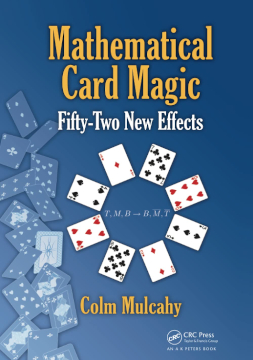
63 years later, the 4-card trick appeared in Colm Mulcahy’s book Mathematical Card Magic: Fifty-Two New Effects. Here the audience chooses not 5 but 4 cards from the standard deck and gives them to the magician’s assistant. The assistant hides one of them and arranges the rest in a row. Unlike in the 5-card trick, in the 4-card trick, the assistant is allowed to put some cards face down. As before, the magician uses the description of how the cards are placed in a row to guess the hidden card.
The strategy for this trick is similar to Cheney’s strategy. First, we assign one particular card that the magician would guess if all the cards are face down. We now can assume that the deck consists of 51 cards and at least one of the cards in the row is face up. We can imagine that our 51-card deck consists of three suits with 17 cards in each suit. Then, the assistant is guaranteed to receive at least two cards of the same imaginary suit. Similar to Cheney’s strategy, the leftmost face-up card will signal the imaginary suit, and the rest of the cards will signal a number. I will leave it to the reader to check that signaling a number from 1 to 8 is possible. Similar to Cheney’s strategy, the assistant has an extra choice: which card of the two cards of the same imaginary suit to hide. As before, the assistant chooses to hide the card so that the value of the hidden card is not more than the value of the leftmost face-up card plus 8. It follows that the maximum number of cards the imaginary suit can have is 17. Magically, the largest possible deck size for performing this trick is 52, the standard deck of cards.
Last academic year, my PRIMES STEP junior group decided to dive deeper into these tricks. We invented many new tricks and calculated their maximum deck sizes. Our cutest trick is a 3-card trick. It is similar to both the 5-card trick and the 4-card trick. In our trick, the audience chooses not 5, not 4, but 3 cards from the standard deck and gives them to the magician’s assistant. The assistant hides one of them and arranges the other two in a row. The assistant is allowed to put some cards face down, as in the 4-card trick, and, on top of that, is also allowed to rotate the cards in two ways: by putting each card vertically or horizontally.
We calculated the maximum deck size for the 3-card trick, which is not 52, as for the 5- and 4-card trick, but rather 54. Still, this means the 3-card trick can be performed with the standard deck. The details of this trick and other tricks, as well as some theory, can be found in our paper Card Tricks and Information.
Share: